Views: 0 Author: Site Editor Publish Time: 2026-08-31 Origin: Site
Buying the wrong vacuum creates hidden business and practical risks. You might burn out a motor instantly from fine dust exposure. You could face inadequate suction for heavy sludge. You might even end up with an oversized unit too heavy to move safely when full. All shop vacuums handle basic spills and dirt easily. However, specific demanding jobs require distinct performance specifications. You must balance airflow capacity against raw water lift. You also need the proper filtration tiers and durable tank materials to succeed. This guide provides a hype-free, spec-driven evaluation framework. It helps you match the right machine directly to your exact application. We will show you how to avoid common marketing traps. You will learn why relying solely on peak horsepower ratings often leads to poor purchase decisions.
Match suction type to the debris: Prioritize CFM (airflow) for dry, bulky debris (woodchips) and Water Lift (sealed suction) for dense liquids and sludge.
Size realistically: A 16-gallon tank full of water weighs over 130 lbs; factor in mobility and drainage needs, not just raw capacity.
Filtration is a strict dependency: Drywall dust and concrete powder require specialized fine-dust or HEPA filters to prevent motor failure and maintain OSHA compliance.
Look beyond peak horsepower: Amperage and motor design dictate sustained performance better than peak HP marketing claims.
Everyday household tasks demand flexibility above raw power. You need a machine capable of navigating tight garage spaces or indoor hallways. Compact storage becomes a primary success criterion here. Maneuverability ensures you can quickly deploy the unit for spilled drinks or dirty car floor mats. Buyers should target capacities between two and six gallons. Lower airflow (CFM) remains perfectly acceptable for mixed, low-volume debris. Instead of chasing high motor specs, focus heavily on accessory availability. You will rely constantly on crevice tools, detailing brushes, and flexible extension hoses to clean awkward corners effectively.
Woodshops and construction sites present an entirely different challenge. Continuous operation separates decent tools from great ones. You need robust fine dust management and high durability against physical impacts. A standard shop vacuum will crack if dropped off a tailgate. Optimal specifications for this class fall in the eight to 14-gallon capacity range. You must secure high CFM ratings (exceeding 100) to pull heavy sawdust and woodchips through long hoses. Furthermore, mandatory fine-dust filtration systems become a hard requirement. Standard filters clog rapidly when exposed to drywall or sanded plaster.
Large-scale facilities demand professional-grade equipment. Success criteria include workflow scalability, strict safety compliance, and efficient fluid management. Sustained uptime drives daily productivity. Investing in a true commercial wet dry vacuum pays dividends in these environments. You should seek models delivering exceptional Water Lift (greater than 60 inches) for rapid liquid extraction. Look for integrated pump-out features to empty tanks continuously without stopping work. Heavy-duty carts featuring steel frames ensure the unit survives harsh industrial environments.
Retailers heavily promote Peak Horsepower (HP) to sell vacuums. You should ignore it. Peak HP acts primarily as a marketing metric rather than a useful performance indicator. Manufacturers measure this figure in a laboratory during the fraction of a second before the motor burns out under maximum load. It does not represent continuous operating power. Instead, we advise buyers to examine continuous Amperage. Standard US 120V electrical circuits typically support a maximum of 12 Amps for continuous loads. Checking the amp draw gives you a highly accurate gauge of the motor's true sustained power capabilities.
CFM measures total airflow volume. It dictates how much air moves through the hose every single minute. You should prioritize CFM when your primary goal involves dry materials. High airflow becomes crucial for picking up dry debris like sawdust, leaves, or plastic shavings. It keeps lightweight dust particles suspended inside the hose over long distances. If your workflow involves woodworking or general shop cleanup, a high CFM rating ensures debris travels rapidly from the floor into the collection tank without clogging the hose.
Water Lift measures sheer pulling force. Technicians test this by sealing the vacuum hose against a column of water and measuring how many inches the motor pulls the liquid upward. You must prioritize Water Lift when tackling dense or wet materials. This metric remains non-negotiable for extracting water deep from flooded carpets. It provides the brute strength needed to pull heavy sludge, wet concrete slurry, or clear clogged plumbing pipes. A unit might boast high CFM, but without adequate Water Lift, it will fail completely at heavy liquid extraction.
Performance Metric | What It Measures | Ideal Application Focus | Good Benchmark Target |
|---|---|---|---|
CFM (Airflow) | Volume of air moved per minute | Wood dust, dry leaves, workshop debris | 100+ CFM for shop use |
Water Lift (Suction) | Sealed pulling force in inches | Flooded basements, dense mud, pipe clearing | 60+ inches for liquid tasks |
Amperage (Amps) | Continuous electrical current draw | Overall sustained motor durability | 10 to 12 Amps maximum |
Many buyers automatically purchase the largest tank available. This creates severe mobility issues on the job. Water weighs roughly 8.3 pounds per gallon. If you fill a 16-gallon vacuum entirely with liquid, the contents alone weigh over 130 pounds. Adding the weight of the motor head makes the unit incredibly difficult to lift or maneuver over thresholds. You must size your tank realistically based on who will operate it. We highly recommend verifying the presence of built-in drain ports at the bottom for any unit exceeding eight gallons. Drain ports eliminate the dangerous need to tip heavy tanks.
Material selection directly impacts longevity and specific use cases. Consider the following options:
Poly (Plastic) Tanks: These remain dent-proof, lightweight, and completely immune to rust. Polypropylene models handle impacts beautifully on busy job sites. They also resist harsh chemicals better than thin metals.
Stainless Steel Tanks: These offer a highly professional aesthetic and remain much easier to sanitize for food service or healthcare environments. Crucially, grounded stainless steel prevents dangerous static build-up. This feature proves vital when vacuuming fine dust like flour or wood powder, though the material remains prone to visual denting.
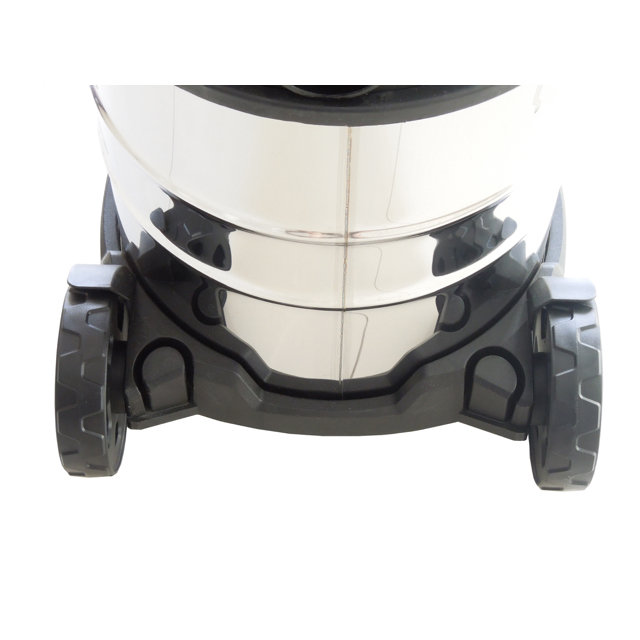
A powerful vacuum becomes useless if it constantly falls over. Top-heavy designs tip easily when you pull them by the hose. You must evaluate the cart setup carefully before buying. To ensure stable, frustration-free mobility, perform these structural checks:
Verify the base possesses a wide stance that extends past the diameter of the tank.
Ensure the unit features 360-degree pivoting casters for multi-directional movement.
Look for non-marring rubber wheels to protect finished indoor flooring.
Check for rear locking wheels to secure the vacuum on sloped driveways.
Filtration stands as a strict operational dependency. Standard filters work sufficiently well for large debris like wood chips or fallen leaves. However, standard pleated paper will clog instantly upon hitting fine dust, causing the motor to overheat. Fine dust filters or specialized collection bags become strictly required for cold ash, drywall dust, and cement powder. Using a disposable collection bag alongside a primary cartridge filter drastically extends overall motor life. HEPA filtration represents the highest tier. True HEPA filters capture 99.97% of airborne particles down to 0.3 microns, keeping your breathing air perfectly clean.
Switching between dry and wet tasks requires a mandatory operational shift. You cannot simply start sucking up water. First, you must remove standard paper or cloth filters entirely. Water ruins pleated paper immediately. Next, you swap to a specialized foam sleeve. The foam sleeve does not filter microscopic dust. Instead, it prevents coarse debris from entering the impeller. More importantly, it stops internal water splashing from being ingested by the spinning motor. Failing to make this simple transition routinely destroys standard vacuums within minutes.
Commercial environments face strict regulatory oversight regarding airborne particulates. When dealing with silica dust generated by cutting concrete or masonry, standard vacuums fail legal requirements. You must deploy OSHA-compliant HEPA machines. These specialized units feature mandatory filter-cleaning mechanisms. They automatically knock dust off the internal filters to maintain constant suction. Upgrading to compliant gear protects your workforce from severe respiratory illnesses while shielding your business from heavy regulatory fines.
Choosing your power source dictates your workflow limitations. The standard electric wet dry vacuum remains the undisputed champion for sustained power. Corded units provide unlimited runtime. They also deliver significantly higher CFM and Water Lift metrics because they utilize direct wall current. However, battery-powered cordless models have gained massive popularity. They remain ideal for quick spot-cleaning and outdoor locations lacking power access. Cordless units eliminate trip hazards entirely. Just remember they come with strict runtime limits and noticeable suction trade-offs compared to corded peers.
Your relationship with the equipment does not end at purchase. Trust factor plays a massive role in long-term satisfaction. It matters deeply to source your equipment from an established vacuum cleaner manufacturer. Off-brand machines might look identical online, but they often use proprietary filter shapes. Decision logic dictates you must look for guaranteed replacement part availability. Ensure the brand commits to supplying replacement hoses, specialized filters, and motor brushes for at least five years. A cheap discount vacuum instantly becomes a permanent liability the moment its proprietary filters are discontinued.
Choosing the correct wet dry vacuum cleaner requires balancing airflow, capacity, and specialized filtration to match your specific environment. Do not get distracted by inflated peak horsepower claims. Instead, define your primary debris type first. If you face heavy liquids, prioritize water lift; if you tackle dry dust, maximize CFM. Always set a strict maximum weight threshold to maintain safe mobility for your crew. Once you establish these baselines, filter your options by budget and filtration tiers. Compare specific models carefully, review detailed specification sheets, and secure a machine built to handle your toughest messes reliably.
A: A wet and dry vacuum cleaner cannot actively wash carpets alone. They excel at extracting liquid from flooded fibers. However, they lack internal pumps to dispense cleaning solutions. You must apply shampoo manually first, scrub the area, and then use the vacuum solely to extract the dirty water.
A: Yes, you absolutely must remove standard pleated paper filters before vacuuming liquids. Water instantly ruins paper materials and causes them to collapse. You must switch to a designated foam wet filter sleeve, which protects the motor from splashing water without restricting airflow.
A: A good CFM rating depends entirely on the workload. For light household duty and car detailing, 50 to 75 CFM works perfectly well. For heavy construction, woodworking, and pulling debris through long hoses, you should target 100 to 150+ CFM.
A: Odors stem from stagnant organic matter. You must empty the collection tank immediately after vacuuming wet debris. Rinse the tank interior and the hose thoroughly with clean water. Allow all components to air dry completely before reattaching the motor head to prevent dangerous mold and bacteria growth.